

Forbes India Spotlight: The Next Chapter of Angel Investing
CLIPPED WINGS: As regulations tighten and venture capital matures, angel investors are writing fewer cheques but focus on the best-of-the-next wave of companies.
– By Payal Ganguly, Forbes India Magazine
Once the first port of call for fledgling startups, angel investors are now writing far fewer cheques as India’s venture capital (VC) ecosystem matures.
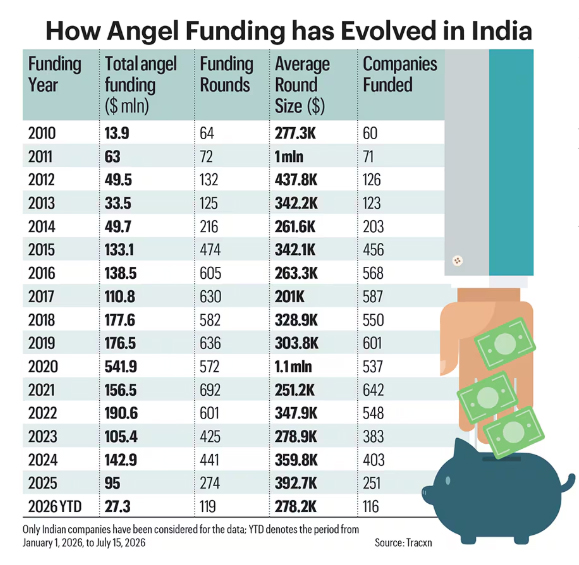
The sharpest drop was witnessed in 2025, when capital deployed by angel investors and platforms in Indian tech companies stood at $95 million, down from nearly $542 million in the Covid year of 2020, according to data from research platform Tracxn. This reflects the Securities and Exchange Board of India’s (Sebi) push towards compulsory accreditation and higher financial thresholds for angel investors in 2025, making compliance a pain point.
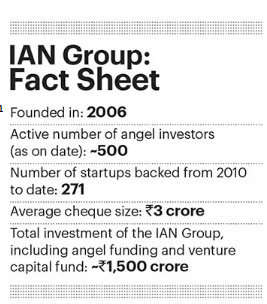
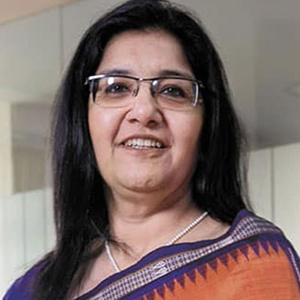
However, angels continue to play a significant role in backing new-age technology companies, often focusing on the “best of the next” instead of going head-to-head with institutional VC firms that can write bigger cheques, observes Padmaja Ruparel, co-founder of IAN Group, the storied angel investment platform which has survived multiple cycles of change.
Backing founders early in their startup journeys comes at great risk. In the case of angel investors, operational insights compared to analytics on sectors that typically do well are the key.
“The role of angels, if I may put it in a broader context, is that we can’t be investing in what is already backed by late-stage investors because you are getting into competition, and your likelihood of making money is lower as they invest in mature companies,” says Ruparel. She adds that, in addition to financial investment, angels bring on board the non-financial investment of time, money, networks and other resources, thus making it important to choose the startups to back.
She adds that the risk levels are different from those of a VC firm as angels invest their own money and bet on sectors they believe in. “We were one of the first to back a stem-cell research company back in the day even when it wasn’t understood well by people. Other than angels, few people would be able to write those cheques,” says Ruparel.
Angel investors, who are sector experts, are a leverage for startups looking to raise follow-on rounds, making it easier for super angels, who form a bridge between institutional networks and VC funds.
Historically, angel networks and city-wise chapters played a crucial role in creating a pipeline of Indian entrepreneurs and startups that were fundable. “Back in 2008 or so, there were very few VC firms in India, and many were arms of US VC firms with an Indian-origin team-member making the calls, with limited understanding of what could be done in India. However, the only groups teaching entrepreneurship were TiE (The IndUS Entrepreneurs), IAN Group, city-specific chapters like Mumbai Angels, Hyderabad Angels, etc, and the cheque sizes were very small,” says Sunil Goyal, founder of early-stage VC firm YourNest Venture Capital.
He adds that, while it served the purpose when cheque sizes were less than ₹1 crore and the ability of people to write those cheques was limited, the scenario has changed today with a complete pipeline in place through incubation and acceleration centres, along with government support and dedicated funding.
“There is seeding of innovation through the incubation centres and accelerators, and, on top of it, we have angel networks offering a structured pipeline of companies,” adds Goyal.
Early on, the US VC firms with a presence in India were interested in backing companies at an average cheque size of $7 million and above, leaving out startups in the early phase of growth, says Ruparel.
“There was a wave of successful Indian entrepreneurs who had grown their ventures and created wealth, and they were the first generation of angel investors, mostly from the IT industry. They were not champagne boys and wanted to share their learnings. Secondly, the VC investments were purely data-driven and did not consider technology or sectors with no previous data,” adds Ruparel, stating that this created the perfect environment for the rise of angel networks and individuals interested in the sector.
With the recent changes in the sector, including regulatory changes, super angels and individual investors have taken a backseat.
“The number of cheques written by individual investors has fallen to just 5 percent of what it used to be at its peak. If I were to look at folks who were investing in the 2018-2020 timeframe, they understand how hard early-stage investing can be in terms of evaluating progress, exploring exits and how long it can take,” says Vaibhav Domkundwar, founder and CEO of Better Capital, who raised his solo fund in 2021. He adds that returns and the 10-year-plus life cycle do not match the expectations of many of the individual angels, leading to fewer investors in the space.
Micro VCs with fund sizes of $20 million to $60 million are now writing first cheques for startups in their sectors of interest. “A lot of micro funds have been launched by astute, smart entrepreneurs and founders are happy to go with them. For us, we are happy to co-invest with these smaller firms, and they act like feeders for us,” says Sasha Mirchandani, founder and managing partner at early-stage venture firm Kae Capital, and a co-founder of Mumbai Angels, which was acquired by wealth and asset management firm 360 ONE in 2023.
Despite early-stage venture firms willing to write smaller cheques for ideas that align with them, angel investment continues to play a key role in nurturing tech innovation among Indian startups. However, most of it is now driven through networks, which reduce the compliance burden on individual investors and can take a broader view of the tech landscape based on combined expertise.
“A network is a risk-mitigation strategy and offers investors a choice, while reducing their individual cheque size. For the founders, it increases the odds of raising capital from a group of investors. Sebi has disallowed consortium-based investing through angel networks, making the cap table founder-friendly with only one person on the board instead of 30,” adds Ruparel. IAN has clocked an average IRR of 25 percent over 20 years since its inception; she adds that the failure rate continues to be around 27 percent.
What the engine needs to keep running is an easier way to unlock private pools of capital from HNIs through easier compliance around net worth and accreditation.